
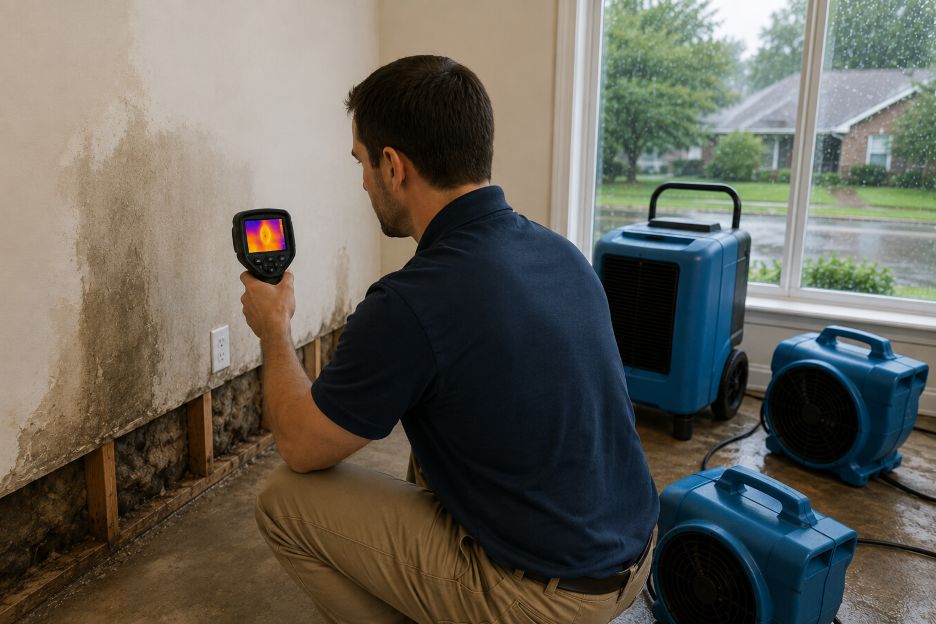
Georgia receives substantial rainfall throughout the year, while warm conditions can keep outdoor humidity high during much of the warmer season. Climate normals maintained by the National Oceanic and Atmospheric Administration show that some parts of the state receive well over 50 inches of precipitation annually. These conditions create a persistent challenge for buildings because water can arrive through storms, plumbing failures, roof leaks, groundwater movement, and drainage problems.
For homeowners dealing with Water Damage Georgia, removing visible water is only one part of the problem. Moisture can remain inside drywall, flooring, insulation, framing, and other materials after surfaces appear dry. Guidance from the U.S. Environmental Protection Agency recommends drying wet materials within roughly 24 to 48 hours where possible because prolonged dampness can encourage mold growth. That makes the debate increasingly important: can better detection and drying technology overcome the moisture pressures created by Georgia’s climate?
1. Why Georgia’s Environment Still Has the Upper Hand
Rainfall is only one side of Georgia’s moisture problem. Humid outdoor air can make natural ventilation less useful during drying. The U.S. Environmental Protection Agency advises keeping indoor relative humidity below 60 percent, ideally between 30 and 50 percent, and specifically recommends dehumidification when outdoor conditions are warm and humid.
Soil adds another variable. Research from the University of Georgia Cooperative Extension explains that saturated hydraulic conductivity determines how readily water moves through soil. Georgia’s soil characteristics vary considerably, meaning water around a building may drain quickly in one location and linger much longer in another.
Piedmont soils illustrate the issue. University of Georgia Extension materials note that soils in this region generally have moderate infiltration and can retain more water than sandier soils. Around poorly drained properties, that can place additional moisture pressure on foundations and crawl spaces.
2. What Changes When Moisture Becomes Measurable?
Traditional water-damage assessment depended heavily on what inspectors could see and feel. Staining, soft drywall, warped flooring, and damp carpet remain useful warning signs, but they provide an incomplete picture when moisture has moved behind finished surfaces.
Modern moisture meters change that comparison. Pin meters can take readings within suitable materials, while non-invasive meters can help identify areas that warrant further investigation. Infrared cameras add another layer by revealing temperature differences across larger surfaces.
These tools do not automatically prove that water is present. Thermal patterns can have several causes, so readings require interpretation and confirmation. Their value lies in narrowing the search and helping technicians make drying decisions using measurements rather than appearance alone.
3. Open Windows or Controlled Drying?
Natural ventilation sounds straightforward: increase airflow and allow wet materials to dry. Georgia’s climate can complicate that approach because introducing warm, moisture-heavy outdoor air may provide limited benefit.
The U.S. Environmental Protection Agency distinguishes between ventilation when outside air is dry and dehumidification when it is warm and humid. This distinction helps explain why commercial drying equipment can be useful in humid climates.
- Air movers increase airflow across wet materials and encourage evaporation.
- Dehumidifiers remove water vapor from the surrounding air.
- Moisture meters help determine whether materials are actually becoming drier.
- Temperature and relative-humidity readings show whether indoor drying conditions are improving.
Used together, these tools create a controlled drying environment. Instead of depending on weather conditions, technicians can adjust airflow and humidity while checking whether moisture levels are moving in the desired direction.
4. Where Industrial Drying Technology Gains Ground
The strongest argument for modern drying systems is control. A building affected by water can contain several different microenvironments. A hardwood floor, insulated wall cavity, concrete slab, and crawl space may respond differently even though they are part of the same property.
Repeated measurements allow drying strategies to be adjusted as conditions change. If one section remains unusually damp while surrounding areas improve, technicians can investigate for trapped moisture, inadequate airflow, or an unresolved water source. This focus on more efficient equipment systems also reflects a broader trend in technology, where better control of airflow, energy use, and mechanical processes can improve how equipment performs while reducing unnecessary waste.
This matters because appearance can be misleading. The U.S. Environmental Protection Agency specifically identifies walls, ceilings, attics, and crawl spaces as areas where hidden moisture may be overlooked. Technology gives inspectors more ways to identify these problem areas before assuming a building is dry.
5. Where Technology Still Falls Short
Better equipment cannot correct a building’s underlying vulnerability to water. A dehumidifier can remove moisture from indoor air, but it cannot repair damaged flashing. An infrared camera may help locate a wet wall, but it cannot redirect stormwater away from a foundation.
That limitation is central to the other side of the argument. U.S. Environmental Protection Agency guidance emphasizes controlling the source of moisture, maintaining gutters, fixing leaks, and ensuring that ground slopes away from foundations. Drying equipment becomes less effective as a long-term solution if water continues entering the structure.
6. Detection and Prevention Work Better Together
Georgia’s climate therefore makes moisture management a building issue as much as a restoration issue. Drainage, roof maintenance, plumbing condition, foundation design, ventilation, and material selection influence how much water reaches vulnerable areas in the first place.
Technology is most useful when it supports those fundamentals. Sensors and meters can identify a problem sooner. Air movers and dehumidifiers can improve drying conditions. Recorded measurements can show whether materials are responding. None of these steps eliminates the need to repair the source.
Can Technology Offset Georgia’s Climate Risks?
The answer falls somewhere between optimism and limitation. Modern moisture-detection tools make hidden dampness easier to investigate, while industrial drying equipment provides more control than waiting for natural evaporation. These advances are particularly valuable where warm, humid outdoor conditions make passive drying unpredictable.
Georgia’s rainfall, humidity, soil behavior, and building vulnerabilities still set the boundaries within which that technology operates. The most resilient approach combines accurate detection and controlled drying with better drainage, maintenance, and water-entry prevention. As sensing equipment becomes more precise and drying systems more efficient, technology should continue improving the response to water intrusion. The climate itself, however, remains a factor that buildings must be designed and maintained to handle.